
A crescent (Hilal) Moon that marked the commencement of the Farewell Hajj (Hajjat-ul-Wadaa) of the Prophet Muhammad ﷺ on Wednesday, 26 February 632 CE – Dhul-Hijjah 10 AH:
The sunset of Wednesday, 26 February 632 CE, corresponds to the moon-sighting date (29 Dhul-Qa‘dah 10 AH) for the beginning of Dhul-Hijjah in 10 AH for those who were present at the Farewell Pilgrimage (Hajjat-ul-Wadaa) with the Prophet Muhammad ﷺ.
This article determines, from the ahadith, the actual date of the moon-sighting day for Dhul-Hijjah 10 AH, the crescent sighting determined the Farewell Hajj (Hajjat-ul-Wadaa). Then presents the calculated astronomical positional numerical likely parameters of the crescent Moon for Dhul-Hijjah 10 AH at sunset on Wednesday, 26 February 632 CE. Also, trying to explore the nearest possible region from which it may have been observed. It also includes a comparative analysis and a personal reflection on witnessing a similar moon myself centuries later, on Thursday, 19 March 2026, in Devon, UK.
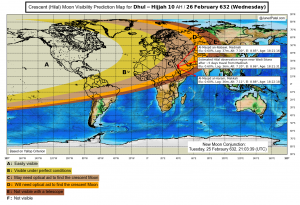
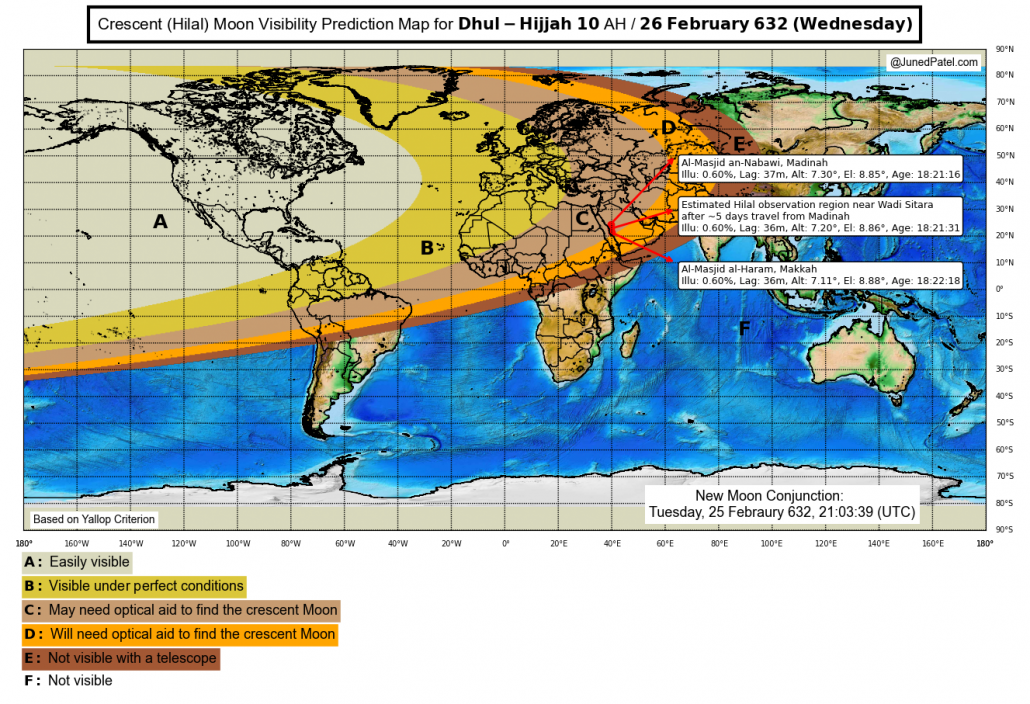
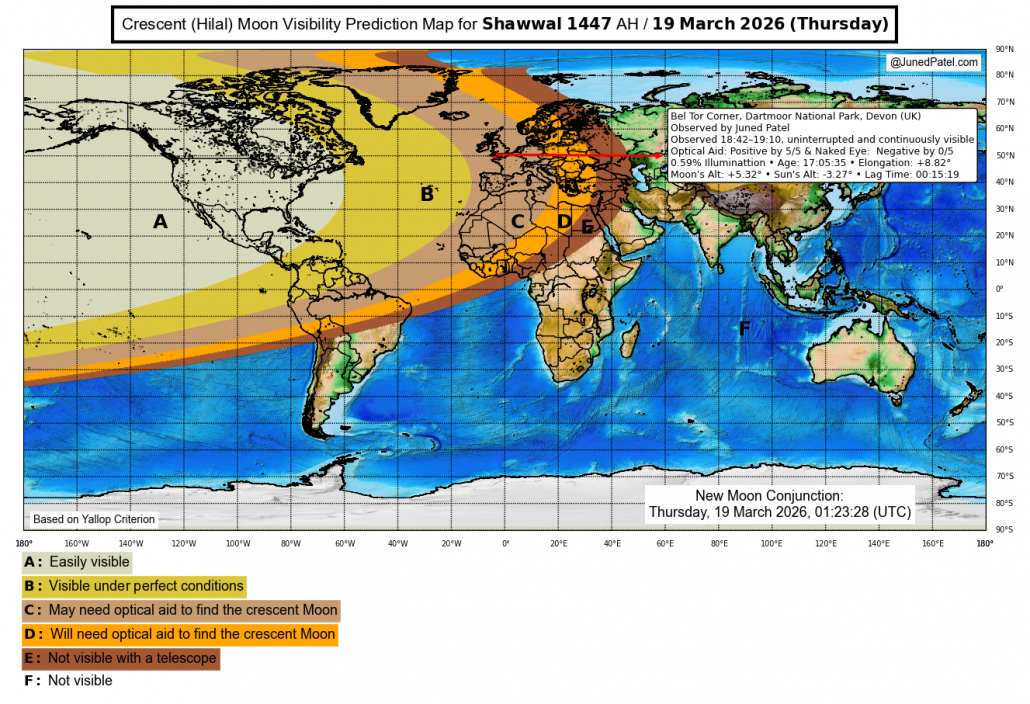
Yallop Crescent Moon Visibility Map for 26 Feb 632 CE – Hajjat al-Wada (Farewell Pilgrimage) – Dhul-Hijjah 10 AH
Using Ahadith to Establish the Timeline of the Journey of Prophet Muhammad ﷺ from Madinah to Makkah:
عَنْ أَنَسٍ ـ رضى الله عنه ـ قَالَ صَلَّى النَّبِيُّ صلى الله عليه وسلم بِالْمَدِينَةِ الظُّهْرَ أَرْبَعًا، وَالْعَصْرَ بِذِي الْحُلَيْفَةِ رَكْعَتَيْنِ،
Narrated Anas: The Prophet ﷺ offered four rakat of the Zuhr prayer in Madinah and two rakat of the Asr prayer in Dhul-Hulaifa. Sahih al-Bukhari: 1548
حَدَّثَنِي عَبْدُ اللَّهِ بْنُ مُحَمَّدٍ، حَدَّثَنَا هِشَامُ بْنُ يُوسُفَ، أَخْبَرَنَا ابْنُ جُرَيْجٍ، حَدَّثَنَا مُحَمَّدُ بْنُ الْمُنْكَدِرِ، عَنْ أَنَسِ بْنِ مَالِكٍ ـ رضى الله عنه ـ قَالَ صَلَّى النَّبِيُّ صلى الله عليه وسلم بِالْمَدِينَةِ أَرْبَعًا، وَبِذِي الْحُلَيْفَةِ رَكْعَتَيْنِ، ثُمَّ بَاتَ حَتَّى أَصْبَحَ بِذِي الْحُلَيْفَةِ، فَلَمَّا رَكِبَ رَاحِلَتَهُ وَاسْتَوَتْ بِهِ أَهَلَّ.
Narrated Anas bin Malik: The Prophet ﷺ offered four rakat in Madinah and then two rakat at Dhul-Hulaifa and then passed the night at Dhul-Hulaifa till it was morning, and when he mounted his Mount, and it stood up, he started to recite Talbiya. Sahih al-Bukhari: 1546
- The Prophet ﷺ performed the Zuhr prayer as four rakat in Madinah prior to leaving, so this day of leaving Madinah cannot be Friday.
- From Madinah, the journey proceeded to Dhul-Hulaifa, where the Prophet ﷺ stayed overnight.
- The main journey towards Makkah began the following day after spending the night at Dhul-Hulaifa.
، وَذَلِكَ لِخَمْسٍ بَقِينَ مِنْ ذِي الْقَعْدَةِ، فَقَدِمَ مَكَّةَ لأَرْبَعِ لَيَالٍ خَلَوْنَ مِنْ ذِي الْحَجَّةِ
And that was when there remained five days from Dhū al-Qaʿdah. And He arrived in Makkah when four nights had passed/elapsed from Dhul-Hijjah. Sahih al-Bukhari: 1545
حَدَّثَنَا مُسَدَّدٌ، حَدَّثَنَا يَحْيَى، عَنْ عُبَيْدِ اللَّهِ، قَالَ حَدَّثَنِي نَافِعٌ، عَنِ ابْنِ عُمَرَ ـ رضى الله عنهما ـ قَالَ بَاتَ النَّبِيُّ صلى الله عليه وسلم بِذِي طُوًى حَتَّى أَصْبَحَ ثُمَّ دَخَلَ مَكَّةَ. وَكَانَ ابْنُ عُمَرَ ـ رضى الله عنهما ـ يَفْعَلُهُ.
Narrated Nafi`: ‘ Ibn `Umar said, “The Prophet ﷺ passed the night at Dhi-Tuwa till it was dawn and then he entered Makkah.” Ibn `Umar used to do the same. Sahih al-Bukhari 1574
- The Prophet ﷺ departed from Madinah when five days of Dhul-Qa‘dah remained. Counting the five remaining days as the 25th, 26th, 27th, 28th, and 29th indicates that the month consisted of 29 days. This places the departure on 25 Dhul-Qa‘dah 10 AH.
- The Prophet ﷺ arrived at some point at the end of the 3rd Dhul-Hijjah at Dhi-Tuwa, which is near Makkah, just 5km away from the Kabah.
- The Prophet ﷺ spent and rested at Dhi-Tuwa on the 4th night of Dhul-Hijjah and entered Makkah during the daytime of 4th Dhul-Hijjah, after dawn. This makes the arrival in Makkah occur after four nights have elapsed from Dhul-Hijjah.
- The standing at Arafah during the Farewell Pilgrimage took place on a Friday.
Determining the Islamic and Gregorian Dates of the Dhul-Hijjah 10 AH Crescent:
| Islamic | Gregorian | Events | mornings | nights |
|---|---|---|---|---|
| 24 Dhul-Qi’dah 10AH | 21 Feb 0632, Fri | Prayed Jumua in Madinah | ||
| 25 Dhul-Qi’dah 10AH | 22 Feb 0632, Sat | Left Madinah, travelled 9.5km | 1st | |
| 26 Dhul-Qi’dah 10AH | 23 Feb 0632, Sun | Left Dhul-Hulaifa | 2nd | |
| 27 Dhul-Qi’dah 10AH | 24 Feb 0632, Mon |
|
3rd
|
|
| 28 Dhul-Qi’dah 10AH |
25 Feb 0632, Tue
|
4th | ||
| 29 Dhul-Qi’dah 10AH | 26 Feb 0632, Wed | Moon Sighting Day for Dhul-Hijjah | 5th | 1st |
| 1 Dhul-Hijjah 10AH | 27 Feb 0632, Thu | 6th | 2nd | |
| 2 Dhul-Hijjah 10AH | 28 Feb 0632, Fri | 7th | 3rd | |
| 3 Dhul-Hijjah 10AH | 29 Feb 0632, Sat | Arrived at Dhi-Tuwa, 5km away from Al-Kabah, and rested overnight |
8th | 4th |
| 4 Dhul-Hijjah 10AH | 1 Mar 0632, Sun | Entered Makkah after the Dawn | 9th | |
| 5 Dhul-Hijjah 10AH | 2 Mar 0632, Mon | |||
| 6 Dhul-Hijjah 10AH | 3 Mar 0632, Tue | |||
| 7 Dhul-Hijjah 10AH | 4 Mar 0632, Wed | |||
| 8 Dhul-Hijjah 10AH | 5 Mar 0632, Thu | The Day of Tarwiyah | ||
| 9 Dhul-Hijjah 10AH | 6 Mar 0632, Fri | The Day of Arafah | ||
| 10 Dhul-Hijjah 10AH | 7 Mar 0632, Sat | The Day of Sacrifice | ||
| 11 Dhul-Hijjah 10AH | 8 Mar 0632, Sun | |||
| 12 Dhul-Hijjah 10AH | 9 Mar 0632, Mon | |||
| 13 Dhul-Hijjah 10AH | 10 Mar 0632, Tue | Left for Madinah |
Based on the above authentic ahadith, it can be established that the Prophet ﷺ stood at Arafah on Friday, 9 Dhul-Hijjah 10 AH, which corresponds to 6 March 632 CE. By counting backwards from this date, the beginning of Dhul-Hijjah can be determined. This indicates that the first evening of 1 Dhul-Hijjah 10 AH would have commenced after sunset on Wednesday, 26 February 632 CE, which corresponds to 29 Dhul-Qa‘dah 10 AH, the likely moon-sighting evening.
Further support is found in narrations stating that the Prophet ﷺ departed from Madinah when five days of Dhul-Qi’dah remained (i.e., the 25th to the 29th). This suggests that Dhul-Qa‘dah consisted of 29 days, placing the departure on 25 Dhul-Qi’dah 10 AH (Saturday, 22 February 632 CE). The completion of these five remaining days aligns with the transition into Dhul-Hijjah. Additionally, reports indicate that the Prophet ﷺ arrived at some point at the end of the 3rd Dhul-Hijjah at Dhi-Tuwa. However, as per the habit of the Prophet ﷺ that he would not enter a city at night time, He ﷺ spent and rested at Dhi-Tuwa on the 4th night of Dhul-Hijjah, which is just 5km away from the Kabah. Then the Prophet ﷺ entered Makkah during the daytime of 4th Dhul-Hijjah 10 AH (Sunday, 1 March 632 CE), after dawn. This places the arrival in Makkah 4 nights after Dhul-Hijjah. Counting backwards from this established date once again confirms that the beginning of Dhul-Hijjah would have occurred after sunset on Wednesday, 26 February 632 CE.
Taken together, these narrations consistently indicate that the month of Dhul-Hijjah 10 AH for those who were present at the Farewell Pilgrimage (Hajjat-ul-Wadaa) with the Prophet Muhammad ﷺ began following the completion of 29 days of Dhul-Qa‘dah, with the crescent (Hilal) most likely observed on the evening of Wednesday, 26 February 632 CE.
Possible Region of Crescent Observation on Wednesday, 26 February 632 CE:
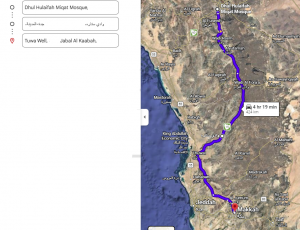
I could be wrong, but as per my limited knowledge, there is no explicit record identifying the exact location where the Prophet ﷺ and his companions رضي الله عنهم observed the crescent (Hilal) of Dhul-Hijjah 10 AH. Therefore, the following approach presents a reasoned estimate of the possible region for the observation location.
The journey began from Madinah, with the Prophet ﷺ travelling to Dhul-Hulaifa, approximately 9.5 km away, where he stayed overnight. This initial stage is excluded from the calculation because it represents a short, atypical travel distance compared with subsequent days. Additionally, because the distance and timing of this stage are known with certainty, it is excluded from the estimates.
From the following day (26 Dhul-Qa‘dah 10 AH), the main journey continued from Dhul-Hulaifa towards Makkah. The Prophet ﷺ is reported to have reached the outskirts of Makkah near Dhi-Tuwa by the end of 3 Dhul-Hijjah and entered Makkah on the morning of 4 Dhul-Hijjah. This indicates a travel period of approximately seven full days, i.e. Dhul-Hulaifa to Dhi-Tuwa (26th, 27th, 28th, 29th, 1st, 2nd, 3rd).
Assuming the caravan followed the established inland route through valleys, the total distance between Dhul-Hulaifa and Dhi-Tuwa is estimated to be approximately 424 km along the modern route of the Jeddah–Madinah corridor. Dividing this distance by 7 days yields an average travel distance of approximately 60.57 km per day.
Earlier, it was established that the month of Dhul-Hijjah likely began after four days of travel from Dhul-Hulaifa, corresponding to the evening of Wednesday, 26 February 632 CE (29 Dhul-Qa‘dah 10 AH). Based on this, the caravan would have covered approximately:
60.4 km × 4 days ≈ 242.29 km from Dhul-Hulaifa
This places the caravan’s probable location in a region roughly just after the midway point along the route. One such location is around Wadi Sitara (approximate coordinates: 22.562316, 39.620435), where the crescent may have been observed for Hajjat-ul-Wadaa after the sunset of Wednesday, 26 February 632 CE.
Astronomical Parameters of the Moon Hajjat-ul-Wadaa (Farewell Pilgrimage) Dhul-Hijjah 10 AH on the Evening of 26 February 632 CE:
From the ahadith, it is evident that the Prophet ﷺ and his caravan were not in Madinah or Makkah, as they were travelling between these locations on the day of moon sighting. Nevertheless, the lunar parameters for both Madinah and Makkah are still presented here for reference and comparison.
For the purpose of this analysis, a region near Wadi Sitara has been used as a reference point, representing the approximate location the caravan may have reached after five days of travel from Madinah. However, it is important to note that there is no definitive way to determine the exact location from which the crescent (Hilal) may have been observed on the evening of 26 February 632 CE.
From an astronomical perspective, the variation in lunar positional parameters along the route between Makkah and Madinah is minimal. For example, the difference in altitude is approximately as little as 0.19°, indicating that uncertainties in the estimated observation location have a negligible impact on the numerical parameters of the crescent anywhere along the route.
To illustrate this, the table below includes the Moon’s positional parameters for Wadi Sitara, Makkah, and Madinah, allowing for a direct comparison across these locations.
All data presented here are calculated for the standard time of sunset. This is due to the absence of precise historical details, such as the exact time after sunset when the crescent was observed, the number of observers, atmospheric conditions (whether it was cloudy), and the duration the moon was visible.
| Location | Possible location | Makkah | Madinah | Devon, UK |
|---|---|---|---|---|
| Location | Wadi Sitara, Saudi Arabia |
Al-Masjid al-Haram, Makkah, Saudi Arabia
|
Al-Masjid an-Nabawi, Madinah, Saudi Arabia
|
Dartmoor National Park, Devon, UK |
| Coordinates |
22.562316, 39.620435
|
21.422487, 39.826206 | 24.467615, 39.611426 | 50.543137, -3.843448 |
| Date | 26 Feb 632, Wed | 19 March 2026, Thu | ||
| Conjunction | 26 Feb 632, 00:03:39 (UTC+3) | 19 March 2026, 01:23:28 | ||
| After Conjunction | 1st Evening | 1st Evening | ||
| Age (G) | 18:21:31 | 18:22:18 | 18:21:16 | 17:03:12 (-01:18:19) |
| Age in Days | 0.76 | 0.76 | 0.76 | 0.70 (-0.06) |
| Illumination | 0.60% | 0.60% | 0.60% | 0.58% (-0.02%) |
| Moon Alt | 7.20° | 7.11° | 7.30° | 7.63° (+0.43°) |
| Elongation | 8.86° | 8.88° | 8.85° | 8.69° (-0.17°) |
| Lag Time | 00:35:59 | 00:35:24 | 00:37:01 | 00:56:38 (+00:20:39) |
| Sunset | 18:25:10 | 18:25:57 | 18:24:55 | 18:26:40 |
| Moonset | 19:01:10 | 19:01:22 | 19:01:57 | 19:23:19 |
| Yallop | C: May need optical aid to find the crescent Moon | |||
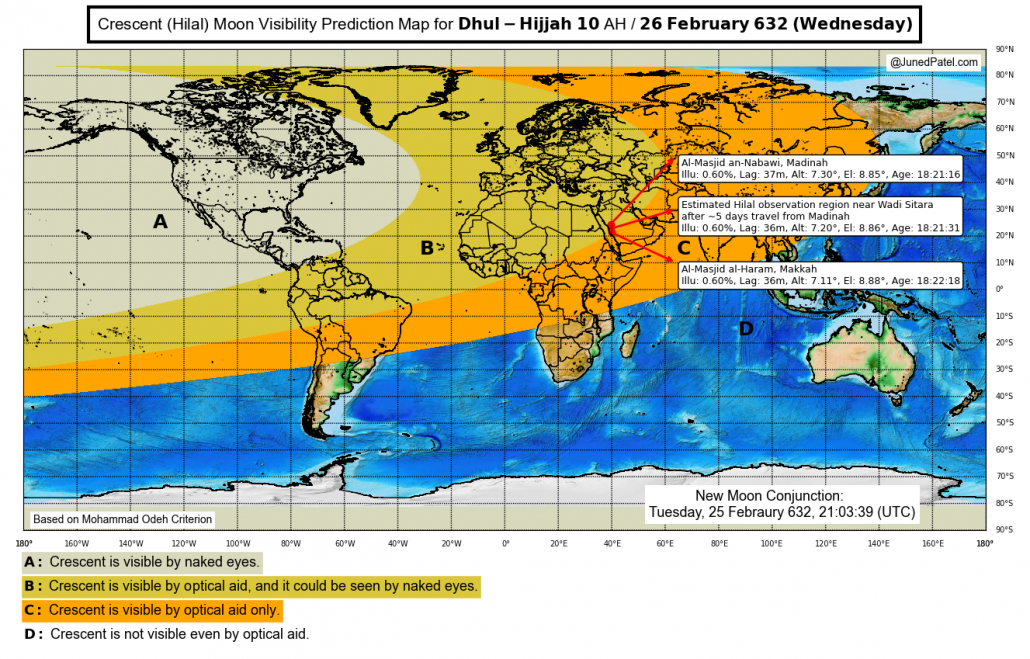
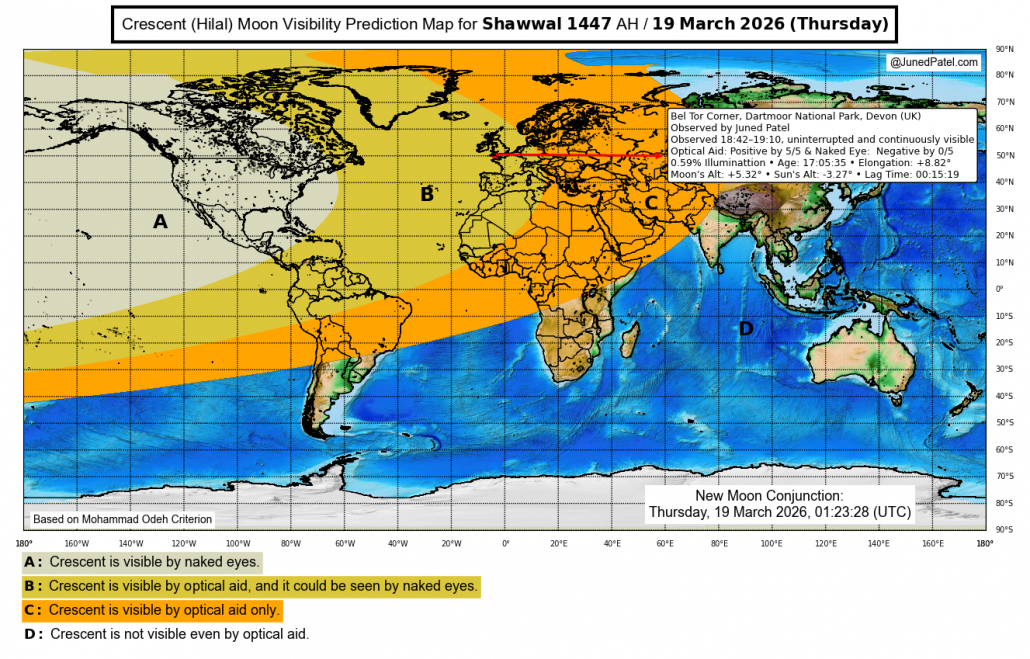
| Odeh | B: Crescent is visible by optical aid, and it could be seen by the naked eyes | |||
| Juned Patel | JP6: Crescents can be visible by optical aid after sunset | |||
Personal Observation and Motivation: Reflecting on the Crescent of 26 February 632 CE and the Farewell Pilgrimage of Prophet Muhammad ﷺ
As a Muslim, I have been observing the crescent moon since childhood. What began as a simple act of tradition gradually developed into something much deeper. Over time, it passed through many stages—most of which were periods of standing behind elders whilst they were searching the moon, excitement, and religious attachment—but eventually curiosity increased, going further began to have a scientific approach, and a serious commitment followed. In recent years, my focus has shifted towards the study of lunar visibility, which requires patience, repeated observation, and attention to fine detail.
During this journey, I recall discussing the crescent associated with the Farewell Pilgrimage (Hajjat-ul-Wadaa) with a colleague in 2021. By this stage, I had already begun approaching moon sighting from a more analytical perspective. When I first examined the likely moon’s parameters at the sunset of 26 February 632 CE, I was genuinely surprised. The moon was only 0.60% illuminated, with an altitude of approximately 7.11°. And of course, I implied that a crescent must have been observed to the naked eye only, as binoculars and telescopes were not available at the time.
Over the years, my chase of crescent observation has been driven by different motivations. More recently, the study of lunar visibility—through data, observation, and comparison—has become a key focus. This has encouraged me to actively seek out difficult and challenging crescents. It is not something I intend to pursue indefinitely, but rather a focused effort to explore specific questions and curiosities within my research.
At the time, I had only just begun to successfully observe very difficult crescents. Yet the crescent moon of 26 February 632 CE remained in my mind at every time, also because it was directly linked to the Farewell Pilgrimage (Hajjat-ul-Wadaa). It stayed with me quietly, in the background, as something I wanted to attempt to observe myself. I began examining future dates and realised that such opportunities are rare.
The first real opportunity came on 8 May 2024. I remember the anticipation clearly. After considering multiple locations abroad, I decided to remain in the UK. I spent the entire day travelling from Bolton in search of a clear western horizon, accompanied by a witness. By sunset, I had reached Reculver, Margate, UK (Illumination: 0.59%, Lag: 67 minutes, Altitude: 7.39°, Elongation: 8.76°, Age: 16:08:09). However, the sky remained fully clouded. The horizon never cleared, and the crescent was not visible. I had to report a negative sighting. https://www.facebook.com/share/p/1CXBMVXtJG/
After seriously waiting for three years, not even being able to properly attempt the observation was deeply upsetting. The effort, the expectation, and then not being able to execute anything—it is difficult to describe that feeling. Yet, moments like this test patience, and I knew I had to continue. I set my focus on the next opportunity.
That opportunity would not come quickly. I knew that 19 March 2026 would offer similar conditions, but it required waiting through 22 lunar months, with no guarantee of success. Weather uncertainty always remains—you can prepare everything and still lose the moment to bad conditions on the horizon.
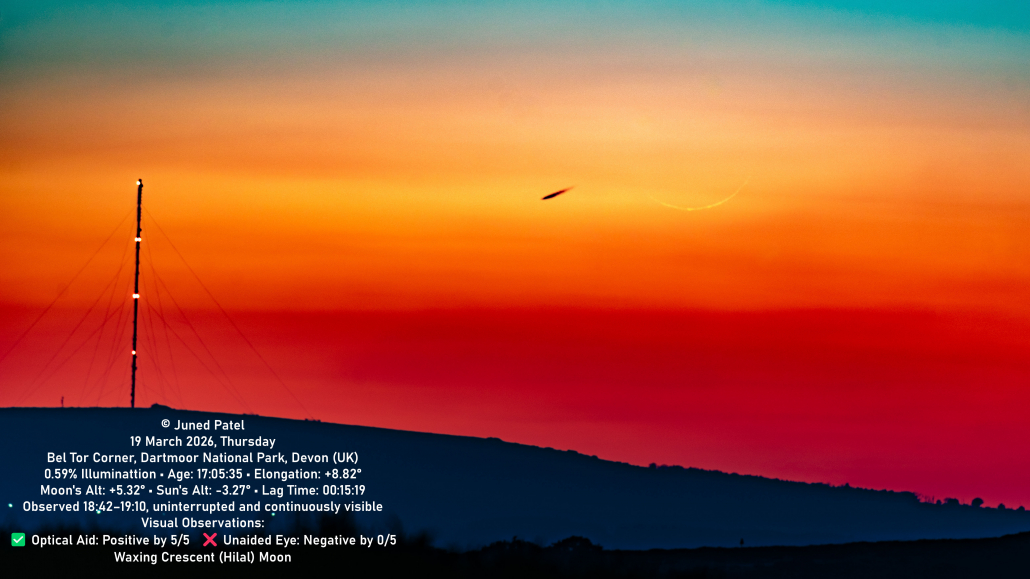
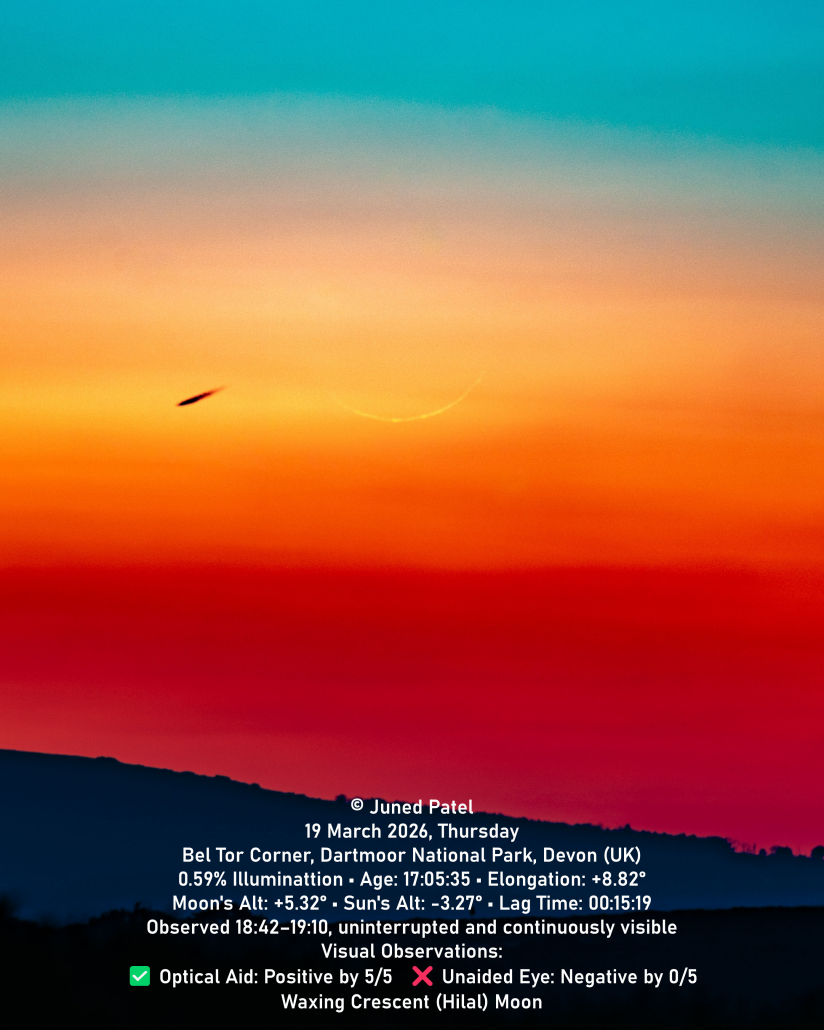
Then, by the will of Allah, I found myself in Devon, UK. This time, the horizon remained clear enough. Using binoculars and a telescope, we observed the crescent for approximately 28 minutes, uninterrupted and continuously visible. Sharing the sighting with four others made the moment even more meaningful.
Yet, even in that success, there remained a quiet sense of incompleteness.
I still remember the first moment I saw it through the telescope. It appeared as a faint, delicate arc—so thin it almost seemed unreal. For initially some minutes, it looked like a broken line of light. Then it reminded me of a sharp blade catching sunlight—fine, bright, and incredibly precise, but it was unevenly illuminated, remember screaming as observing, wow, it looks like a broken arc, split moon. As the minutes passed, the crescent became clearer, extending, gaining form and was seen easily without any effort, but thin.
That evening, I did not manage a proper naked-eye attempt at the right moment. I was occupied—helping others see it, trying to capture it in photographs, unsure whether any image would even come out. In that moment, documentation and sharing took priority. But later, I realised I had missed the chance I had been quietly hoping for.
The Prophet ﷺ and his companions would have observed such a thin crescent without optical aid, as instruments like binoculars and telescopes were not available. In my case, the crescent was observed only with binoculars and a telescope. Notably, the moon on 26 February 632 CE (0.60% illumination) had an altitude of approximately 7.20°, -0.43° lower than mine in Devon alt at sunset, the 7.63° (0.58% illumination), yet I was still unable to observe it with the naked eye.
If these calculated numerical parameters align correctly with the sunset of 26 Feb 632, then observing such a thin crescent at a relatively low altitude with the naked eye would be remarkable.
As someone deeply engaged in lunar visibility, I find this an open question in my study, leaving a lingering desire to one day witness such a delicate crescent unaided and better understand that experience.
It is also worth reflecting on whether environmental conditions over the past 1400 years may have differed from those we experience today. Could the atmosphere have been clearer, allowing for better visibility? To what extent human activity and development have influenced changes in climate, atmospheric composition, and horizon clarity is difficult to say. It remains an open question.
And so, the pursuit continues. The challenge, however, is that the next opportunity for a very similar crescent in the UK will come after many years. Whether I will still be actively observing by then is uncertain—but In Sha Allah, I hope I will be.

What a great writing. It gives insight into one of the most important moments in the history of Islam It gives me a sense of following the farewell pilgrimage while also readying for challenging moon sighting.
Thank you.
Br Abdul Aziz, I appreciate you taking the time to read my long post and for confirming that I got my message across. 🙂
Salam Br Juned Patel,
This is an excellent analysis of the historical date of farewell Hajj moon sighting of Prophet Muhammad (ﷺ), MashaAllah. It matches my own research in 2010 (Ref1) at the request of UK scholars who were investigations crescent moon visibility parameters for both the Farewell Hajj in Makkah (10 AH) and the Demise in Madinah (11 AH) of Prophet Muhammad (ﷺ), which also proved local sighting was the practice of Prophet Muhammad (ﷺ) and his companions (ra), as explained on our ICOUK website.
It is possible that naked-eye sightings were much easier in Makkah during the Farewell Hajj (632 AD/10 AH), as they didn’t have light pollution with and had better eyesight acuity to detect faint objects from high altitudes. In my view, modern optical aids like binoculars/telescopes (refractors) simply help to see the faint crescent moon in the evening sky (with light-gathering and magnification properties), and hence they should be allowed for moon sighting.
PS.
You may also wish to investigate the Solar Eclipse in Madinah (10 AH) when the son of Prophet Muhammad (ﷺ) died, to prove that the next month started a day after the eclipse and not on the same day!
Wassalam,
Qamar Uddin, ICOUK (7/4/2026)
Ref1: Makkah and Madina calendar (10 AH): https://www.moonsighting.org.uk/images/eclipses/MakkahMadinah10AH.jpg
Br Qamar Uddin, Thank you for reading my work and for your kind appreciation. And yes, I do remember reading your research many years ago. I’ve written more about it as well, and I’ll share it another time with more details, In Sha Allah.